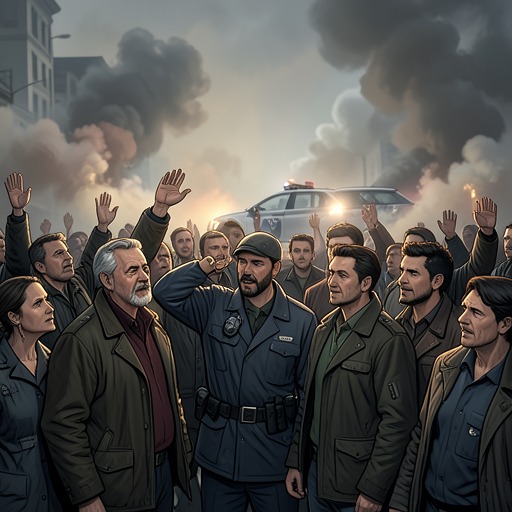
Los Angeles Police Department
American WomanThe Los Angeles Police Department is presented as a law-enforcement institution drawn into the pursuit of the revolutionary cadre and, in the cadre’s broadcast, as a symbol of the power and public theater surrounding the Los Angeles siege. Its role is concrete as well as rhetorical: a recovered handgun points investigators toward the group’s location, while the chief’s reported treatment of the siege’s aftermath becomes material for the group’s political indictment.
Investigation and the Cadre’s Escape
During the cadre’s flight from a sporting-goods store, members abandon a van and take other vehicles. A parking ticket left in the van bears the address of their safe house. At the same time, the handgun lost in the struggle is on its way to the Los Angeles Police Department. The weapon had been purchased years earlier in Juan’s own name, making its ownership traceable. Together, the gun and the forgotten ticket compromise the group’s effort to keep the safe house hidden: the weapon helps authorities recognize that the cadre is in Los Angeles rather than San Francisco, while officers comb the abandoned van and discover the ticket.
The episode gives the department a role in an unintended chain of exposure rather than depicting an elaborate investigative operation. The fugitives’ procedures tell them not to return to a safe house if they might lead pursuers there, but they have already left behind two separate paths to it. Their attempt to escape detection is undone by ordinary evidence: a registered purchase and a piece of paper in an abandoned vehicle.
The Siege in the Broadcast
The department also enters the story through a radio broadcast about the Los Angeles confrontation. Yvonne’s report catalogs particulars of the operation, including its duration, snipers, helicopters, rifles, tear-gas canisters, injured bystanders, deaths, and cost to taxpayers. Juan then transforms those reported details into a sweeping political denunciation, describing the cadre’s dead as comrades and the authorities as their opponents. His speech is the cadre’s framing of the conflict, not a neutral account of the department’s conduct.
In that broadcast, Juan cites a report in the Los Angeles Times claiming that, after the battle, the Los Angeles police chief collected some of the cadre’s shotgun shells from the rubble because he admired their size and had them made into lapel pins for his subordinates. Juan presents the pins as souvenirs of an overwhelming state victory and contrasts them with the cadre’s losses. The detail gives a small physical object—the shell—an emblematic role: in his telling, it links the violence of the siege to the officials’ ability to turn its remains into mementos.
Public Authority and Political Contest
The Los Angeles Police Department’s presence is bound up with competing accounts of what the confrontation means. The cadre’s tape describes its dead as victims of a vastly unequal battle and casts its own survival as a continuation of the struggle. Its language is openly propagandistic, converting reported operational details into a broader claim about state power and political violence. The department, by contrast, appears in the supplied scenes through the recovery and tracing of evidence and through the chief’s reported response to the rubble.
That gap between evidence and interpretation matters to the organization’s place in the narrative. The handgun and ticket have immediate consequences for the fugitives’ security; the shells acquire their significance through the story told about them. The department is therefore both an active instrument of pursuit and a public object of interpretation, though the account of the chief’s lapel pins reaches the reader through the cadre’s broadcast rather than through an independent scene of the chief making them.
Narrative Significance
The department’s role connects the practical mechanics of a manhunt to the struggle over public identity. A handgun bought under Juan’s real name and a ticket left on a dashboard help expose the safe house, while the cadre’s broadcast attempts to shape how listeners understand the siege and its aftermath. In this contrast, the Los Angeles Police Department is not only an obstacle in the fugitives’ escape: it is also part of the contested story through which the group presents itself, its dead, and the force pursuing it.